“Everybody’s looking under every rock.” Jay Kloepfer

By: Russ Kamp, CEO, Ryan ALM, Inc.

Institutional Investor’s James Comtois has recently published an article that quoted several industry members on the near-term (10-years) return forecast for both public and private markets, which according to those asked are looking anemic. No one should be surprised by these forecasts given the incredible strength of public markets during the past three years and the fact that regression to the mean tendencies is not just theory.

An equally, if not greater, challenge is liquidity. As the title above highlights, Jay Kloepfer, Director of Capital Markets Research at Callan, told II that “Liquidity has become a bigger issue,” He went on to say that “Everybody’s looking under every rock.” Not surprising! Given the migration of assets from public markets to private during the last few decades. The rapid decline in U.S. interest rates certainly contributed to this asset movement, but expectations for “outsized” gains from alternatives also fueled enthusiasm and action. The Callan chart below highlights just how far pension plans have migrated.

I’ve written a lot on the subject of liquidity. Of course, the only reason that pension plans exist is to fund a promise that was made to the participants of that fund. Those promises are paid in monthly installments. Not having the necessary liquidity can create significant unintended consequences. No one wants to be a forced seller in a liquidity challenged market. It is critical that pension plans have a liquidity policy in place to deal with this critical issue. Equally important is to have an asset allocation that captures liquidity without having to sell investments.

Cash flow matching (CFM) is such a strategy. It ensures that the necessary liquidity is available each and every month through the careful matching of asset cash flows (interest and principal) with the liability cash flows of benefits and expenses. No forced selling! Furthermore, the use of CFM extends the investing horizon for those growth assets not needed in the CFM program. Those investments can just grow unencumbered. The extended investing horizon also allows the growth assets to wade through choppy markets without the possibility of being sold at less than opportune times.

So, if you are concerned about near-term returns for a variety of assets and with creating the necessary liquidity to meet ongoing pension promises, don’t rely on the status quo approach to asset allocation. Adopt a bifurcated asset allocation that separates plan assets into liquidity and growth buckets. Your plan will be in much better shape to deal with the inevitable market correction.

What Topics Would You Pick?

By: Russ Kamp, CEO, Ryan ALM, Inc.

I’m hopefully attending the FPPTA conference in Orlando beginning on Sunday, February 1, 2026. My attendance will be very much dependent on the path of the next winter storm takes as it migrates up the East coast. I’ve been asked to speak on a couple of occasions at this event for which I’m always very appreciative to be given the opportunity to share my perspectives on a variety of pension subjects.

The first opportunity is straightforward in that I will be addressing the importance of cash flow in managing defined benefit pension plans. In my opinion, there is nothing more important than generating and managing cash flow to meet ongoing plan liabilities of benefits and expenses. As pension plans have pursued a more aggressive asset allocation utilizing significantly more alternatives – private equity, private credit, real estate infrastructure, etc. – liquidity has become more challenging. As a result, some of the strategies that have been adopted to raise the necessary cash flow are not in the best interest of the plans longer term. I’ll be happy to share my thoughts on those issues if you want to reach out to me.

Regarding my second opportunity to share some perspective, I am one of four individuals who were asked to identify three pension related topics for a session called “Around the Pension World Discussion”. There will be six randomly selected topics from the original list of 12 that will be covered in 15-minute increments. It is a really interesting concept, and hopefully as we lead the conversation will get great input from the attendees.

The three topics that I chose are:

  1. Liquidity – it is being challenged through the migration of assets to alternative strategies.
  2. Uncertainty – Human beings hate uncertainty as it has both a physiological and psychological impact on us. Yet little to none of our current practices managing pensions brings certainty.
  3. The Primary Pension objective – managing a DB pension is about securing the promised benefits at a reasonable cost and with prudent risk. It is not a return objective.

Clearly, there are tons of topics covering investments/asset allocation, risk management, governance, actuarial assumptions, plan design, etc. It shouldn’t be surprising why I chose the topics that I did based on my focus on securing pension promises through cash flow matching (CFM). We provide the necessary liquidity to meet those ongoing expenditures, while securing the promises given to the plan participants. In addition, CFM is a “sleep-well-at-night” strategy that brings certainty to the management of pension plans that engage in very uncertain practices.

What topics would you have chosen? Please reply to this post. I’d like to share your topics and the rationale behind choosing them in a follow-up blog. Have a great day!

ARPA Update as of January 23, 2026

By: Russ Kamp, CEO, Ryan ALM, Inc.

I hope that those of you that were in the path of Fern, a storm that impacted 220 million folks in 36 states, have safely dug out at this time. I’m five shoveling expeditions in and I’m still not done! If you are still digging, but safe!

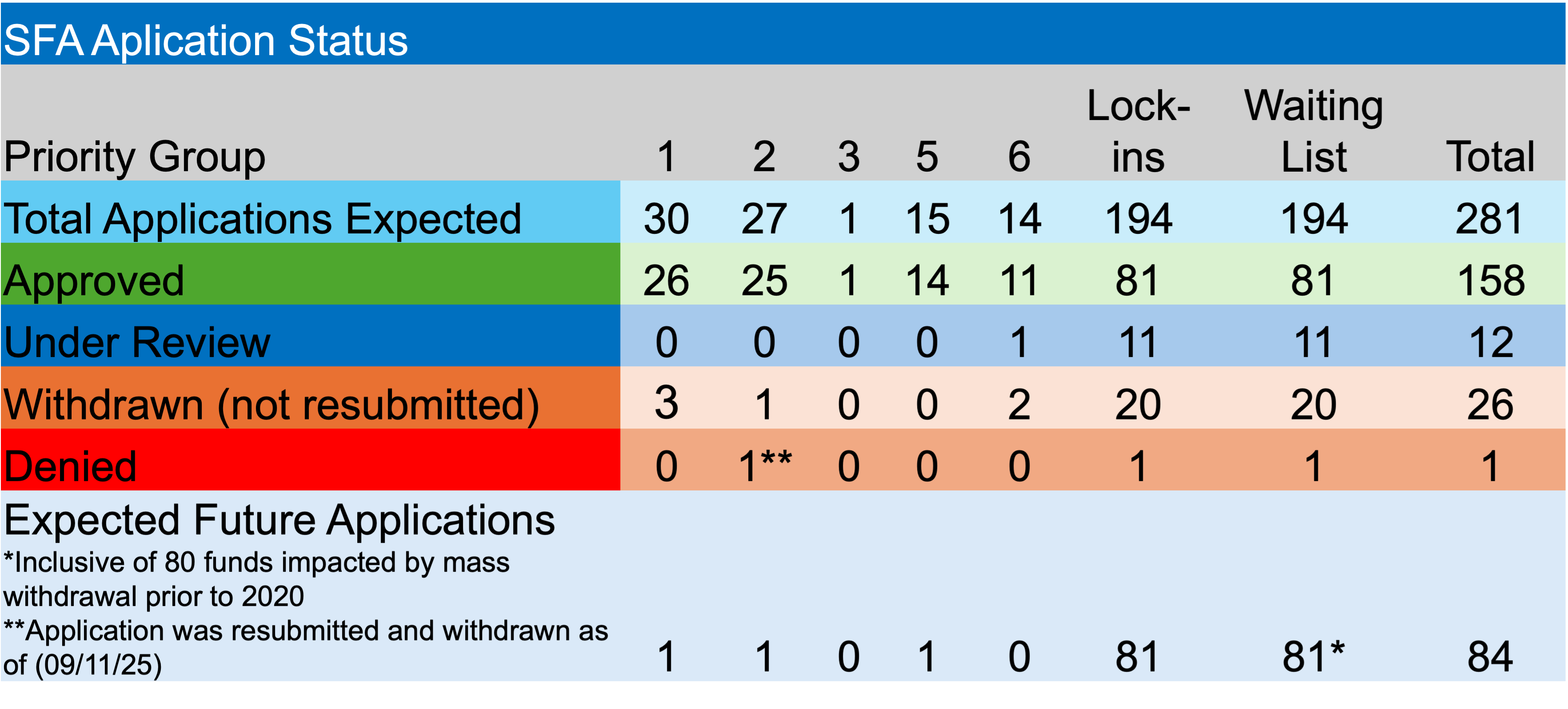
Regarding ARPA, the week ending January 23rd was relatively quiet, as the only activity had one plan withdrawing an application. Ironworkers’ Local 340 Retirement Income Plan pulled its initial application. This non-priority group member is seeking $44.7 million for the 819 plan participants.

Since that was the only activity on the latest spreadsheet, it means that no applications were received through the PBGC’s eFiling portal, no applications were approved or denied, no pension funds were asked to redeem portion of the SFA grant due to census errors and no multiemployer plans sought to be added to the waitlist.

Regarding the waitlist, I am still trying to understand why one still exists since the legislation made it clear that funds not submitting an initial application seeking SFA by December 31, 2025, would not be permitted to do so following that date. Not only does one still exist, but there are more than 80 funds residing on it.

Again, we hope that everyone is staying warm and dry. Be careful shoveling the snow. It doesn’t seem like we are going to get a heat wave anytime soon to help with that task! Finally, who will it be: Seattle or New England?

Another Cockroach!

By: Russ Kamp, CEO, Ryan ALM, Inc.

As most folks were focused on the massive snowstorm that crippled a large swath of the U.S., BlackRock was disclosing another significant loss in one of their private debt funds. In this case, BlackRock TCP Capital, a publicly traded middle-market lending fund, expects to mark down the net value of its assets 19 per cent after a string of troubled loans weighed on results, marking the latest sign of pressure in the private credit market.

BlackRock’s vehicle is a business development company (BDC), which pools together private credit loans and trades like a stock. According to multiple reports, the fund has struggled in part because of its exposure to e-commerce aggregators which are companies that buy and manage Amazon sellers. Furthermore, BDC shares have been hit over the past year. There are currently 156 active BDCs, of which 50 are publicly traded. BDC Investors have concerned over private credit returns, underwriting standards and increased regulatory scrutiny. FINALLY!

Of course, this is not an isolated incident for either private credit/debt in general or specifically BlackRock. As you may recall, BlackRock was forced to reprice a private debt holding from par to zero last November, when Renovo Home Partners, a Dallas-based home-remodeling roll‑up that collapsed into Chapter 7 bankruptcy, triggering a roughly $150 million total loss on a private loan largely held by BlackRock.

Funds managed by BlackRock (notably its TCP Capital Corp. BDC) provided the majority of roughly $150 million in private credit to Renovo, while Apollo’s MidCap Financial and Oaktree held smaller slices. As of late September 2025, lenders were still marking this loan at 100 cents on the dollar, implying expectations of full repayment. This shouldn’t have come as a complete surprise because earlier in 2025, lenders had already agreed to a partial write‑off and debt‑to‑equity swap, trying to stabilize Renovo’s capital structure.

This unfortunate outcome highlights how “mark‑to‑model” valuations in private credit can keep loans at par until very late, then reprice suddenly when a borrower fails. This practice suggest that headline yields in private credit may understate true default and loss severity risk, especially for highly leveraged sponsor‑backed roll‑ups. Yet, it doesn’t seem to have rattled either the market or institutional asset owners who continue to plow significant assets into this opaque and potentially saturated market. It continues to amaze me the number of “searches” being conducted for private credit/debt. Asset classes can get overwhelmed driving down future returns. Do you know what the natural capacity is for this asset class and the manager(s) that you are hiring? Caveat emptor!

How Does One Secure A Benefit?

By: Russ Kamp, CEO, Ryan ALM, Inc.

We hope that you’ll agree that going to Chicago in January demonstrates the lengths that Ryan ALM personnel will go to help plan sponsors and their advisors protect and preserve DB pension plans. We are just thankful that we left yesterday, as today’s temperature is not expected to get to 0. OUCH!

Ron Ryan and I spent the last couple of days speaking with a number of funds and consultants about the many benefits of cash flow matching (CFM), which is gaining incredible traction among pension sponsors of all types. Who doesn’t want an element of certainty and enhanced liquidity within their plans given all the uncertainty we are facing in markets and geopolitically.

The idea of creating an element of certainty within the management of pension plans sounds wonderful, but how is that actually achieved? This is a question that we often receive and this trip was no exception. We had been discussing the fact that the relationship between asset cash flows (bond principal and interest) and liability cash flows (benefits and expenses) is locked in on the day that the bond portfolio is produced. The optimization process that we created blends the principal and interest from multiple bonds to meet the monthly obligations of benefits and expenses with an emphasis on longer maturity and higher yielding bonds to capture greater cost reduction of those future promises.

However, to demonstrate how one defeases a future liability, my example below highlights the matching of one bond versus one future $2 million 10-year liability. In this example from 18-months ago we purchased:

Bond: MetLife 6.375% due 6/15/34, A- quality, price = $107.64

Buy $1,240,000 par value of MetLife at a cost = $1,334,736

Interest is equal to the par value of bonds ($1,240,000) times the bond’s coupon (6.375%)

As a result of this purchase, we Receive: 

  Interest =  $78,412.50 annually ($39,206.25 semi-annual payments)

                            Total interest earned for 10 years is $784,125

  Principal = $1,240,000 at maturity (par value)

Total Cash Flow = $2,024,125  – $2,000,000 10-year Liability  = $24,124.99 excess

                             ($24,124.99 excess Cash Flow)

Benefits:

Able to fund $2 million benefit at a cost of $1.335 million or a -33.25% cost reduction

Excess cash flow can be reinvested or used to partially fund other benefits

In today’s yield environment, our clients benefit to a greater extent asking us to create longer maturity programs given the steepness of the yield curve. If they don’t have the assets to fund 100% of those longer-term liabilities, we can defease a portion of them through what we call a vertical slice. That slice of liabilities can be any percentage that allows us to cover a period from next month to 30-years from now. In a recent analysis produced for a prospect, we constructed a portfolio of bonds that covered 40% of the pension plan’s liabilities out to 30-years. As a result, we reduced the present value cost to defease those liabilities by –42.7%!!

Reach out to us today to learn how much we can reduce the future value cost of your promised benefits. We do this analysis for free. We encourage you to take us up on our generous offer.

ARPA Update as of January 16, 2026

By: Russ Kamp, CEO, Ryan ALM, Inc.

We hope that the continuing success of the ARPA pension legislation warms your heart despite ridiculously cold temperatures in New Jersey and elsewhere.

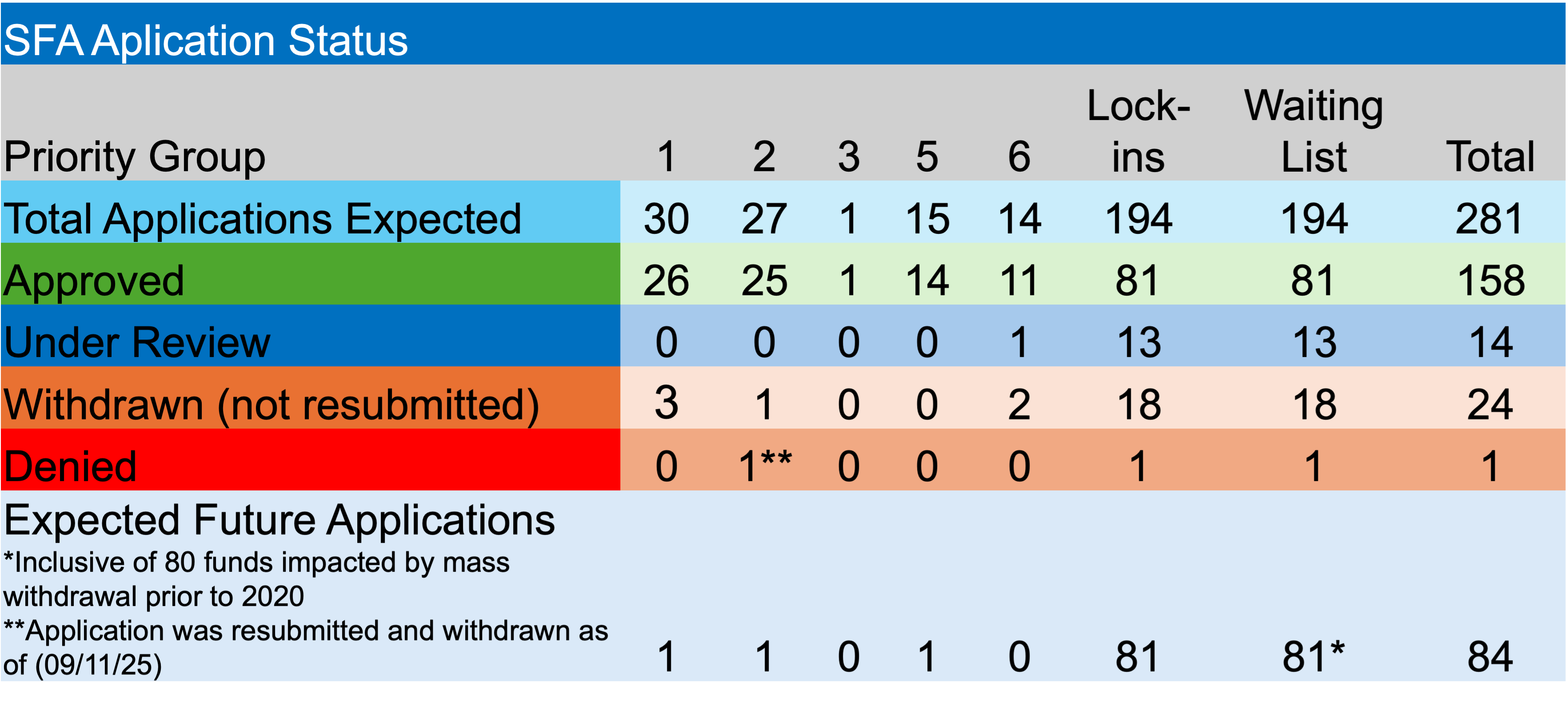
Regarding last week’s activity, pleased to report that two plans received approval for their SFA applications. Pension Trust Fund Agreement of St. Louis Motion Picture Machine Operators and Teamsters Local 837 Pension Plan, both non-priority group members, will receive a combined $19.9 million in SFA and interest for their 1,431 members. These approvals are the first for the PBGC in just under one month.

In other ARPA news, there were no new applications filed, as the e-Filing portal remains temporarily closed. In addition, as we’ve been reporting, the window for initial applications to be submitted was to close on 12/31/25. From this point forward, only revised applications should be received by the PBGC. Despite that impediment, two more funds, NMU Great Lakes Pension Fund and UFCW Pension Fund of Northeastern Pennsylvania, added their names to the extensive waitlist seeking Special Financial Assistance. These plans and the others currently on the list must believe that the current deadline in place will be amended.

There was one application withdrawn during the prior week, as the Dairy Employees Union Local #17 Pension Plan pulled their initial application seeking $3.5 million in SFA for the 633 plan participants. Under the current rules, they have until 12/31/26 to resubmit a revised application.

Lastly, there were no applications denied nor were any of the previous recipients of SFA asked to rebate a portion due to census errors.

The U.S. interest rate environment is reacting to some of the global uncertainty. As a result, longer dated Treasury yields are marching higher. As of 9:51 am, the yield on the 30-year Treasury bond is 4.93%, while the 10-year Treasury note yield is at 4.29%. These yields are quite attractive for plans receiving SFA and wanting to secure benefits and expenses with the proceeds. Don’t miss this opportunity to significantly reduce the cost of those future benefits.

Is A “K” Truly Representative?

By: Russ Kamp, CEO, Ryan ALM, Inc.

I recently attended the Opal Public Fund Forum in Arizona. I’ve always appreciated the opportunity to attend and speak at Opal’s pension conferences. This latest version was no exception. However, I found it interesting that there were two thoughts being expressed over and over again. First, many presenters talked about uncertainty. The other idea centered on the current economic environment, which was frequently described as being K-shaped.

Regarding uncertainty, we often write about the onerous impact of uncertainty on individuals, both from a psychological as well as a physiological standpoint. Yet the pension community continues to embrace uncertainty through implementation of traditional asset allocation approaches, which are potentially subject to significant market events. Why? I’m not going to dwell on this topic today as I’d rather focus some attention of the current economic environment, and I’ve covered many times how Ryan ALM can bring certainty, and a sleep-well-at-night approach, to pension management.

As the title above questions, is defining the current economic environment as a K appropriate? When I look at the letter K, it says to me that 50% of something is advancing while another 50% is declining. Is that what is happening in today’s economy? Are 50% of American workers showing strong economic gains, while 50% struggle? I would say, “NO”! No matter what metrics one reviews, indications are that a far greater percentage of the American workforce is struggling to meet basic living needs than a K would suggest. I’m not sure what letter truly represents today’s conditions, but when only 10%-20% of our households are seeing improved conditions that doesn’t conjure up a K in my mind.

The idea of American Exceptionalism is being challenged by today’s economic realities. It is so disappointing given the potential that we possess as a nation. However, our collective wealth continues to be concentrated among a small percentage of American households at the same time that expenses for basic needs – housing, medical coverage, education, childcare, food, insurance, utilities, and retirement – continue to challenge most budgets.

In a recent article by Adam Bonica, titled “The Wall Looks Permanent Until it Falls”, Adam highlights (lowlights perhaps) the significant differences in key metrics relative to a U.S. peer democracy group of 31 developed nations (OECD). For instance, he shows multiple stats in four broad categories, including Economy and Inequality, Family and Livelihood, Survival and Safety, and Institutions and Justice. It is not to say that these peers don’t have these issues – they do. They just experience them at much lower rates. The comparisons that Mr. Bonica focused on were just the averages for the peer group relative to the U.S., and they prove quite stark.

For instance, the peer average for the Top 1% of households by income is 12.8%, while in the U.S. it is 21%! If the Top 1% of earners just took 12.8%, every American household would get an additional $19k/year. If the Top 1% of Household wealth in the U.S. only had 23.2% of the country’s wealth instead of the 30.6% it currently has, every American household would have an additional $96k. A big expenditure every year for American households is healthcare. Our peers average 9.2% of one’s household spending while we average 17.1%. Just matching the rate of spending would reduce our annual expenditure for healthcare by -2.1T/year. Oh, and it isn’t like our “investment” in healthcare is reaping longevity rewards – it isn’t, as we average -4.1 years less than our average peer (78.4 years versus 82.5 years).

We can do a lot better as a society and economy. There are currently 15 million Americans working full-time that earn a level of income that is below the poverty line. Not acceptable. Only about 10% of the American workers are in DB pension plans. As I’ve stated many times, asking untrained individuals to fund, manage, and then disburse a “benefit” without disposable income, no investment acumen, and no crystal ball to help with longevity is just poor policy. Again, we can do better. Ron and I and the Ryan ALM team are focused on protecting and preserving DB pension plans. I wish that we could do more!

If It’s Good Enough for the Swiss

By: Russ Kamp, CEO, Ryan ALM, Inc.

WTW has published the results for their Swiss Pension Index. Swiss funds are performing exceptionally well with the average funded ratio hitting 128.5% at year-end. The improved funding reflects strong asset performance and the impact of rising interest rates which lowered the present value of future liabilities (benefit payments). Despite the good news, WTW warns investors to be cautious “given the currently elevated valuations in global equity markets a market correction could potentially be around the corner, so continued discipline and prudent risk management is required.”

Given the uncertainty that is always present in the management of defined benefit pension plans whether in the United States or abroad, we always recommend a disciplined and prudent risk management approach. Our sentiment isn’t restricted to U.S. markets. “Pension funds should continuously monitor their portfolios as market, interest rate, and geopolitical conditions evolve,” recommends Alexandra Tischendorf, Head of Investment at WTW Switzerland.

Importantly, Ms. Tischendorf shared that “we (WTW) are also seeing increased adoption of cash flow–driven investment (CDI) approaches, particularly for liabilities with fixed payment profiles. These strategies align investment returns more closely with expected cash flows and can enhance portfolio resilience compared to traditional duration-based approaches.” YES!

We’ve often shared through our blogs and research that cash flow matching (CFM) strategies are superior to duration-only implementations, as you get a more precise duration match through CFM, while also getting the liquidity to meet ongoing benefits and expenses. As always, we are happy to provide a free analysis to any pension plan sponsor that wants to understand what is possible through CFM. Don’t be shy!

ARPA Updated as of January 9, 2026

By: Russ Kamp, CEO, Ryan ALM, Inc.

We hope that 2026 has begun well for you.

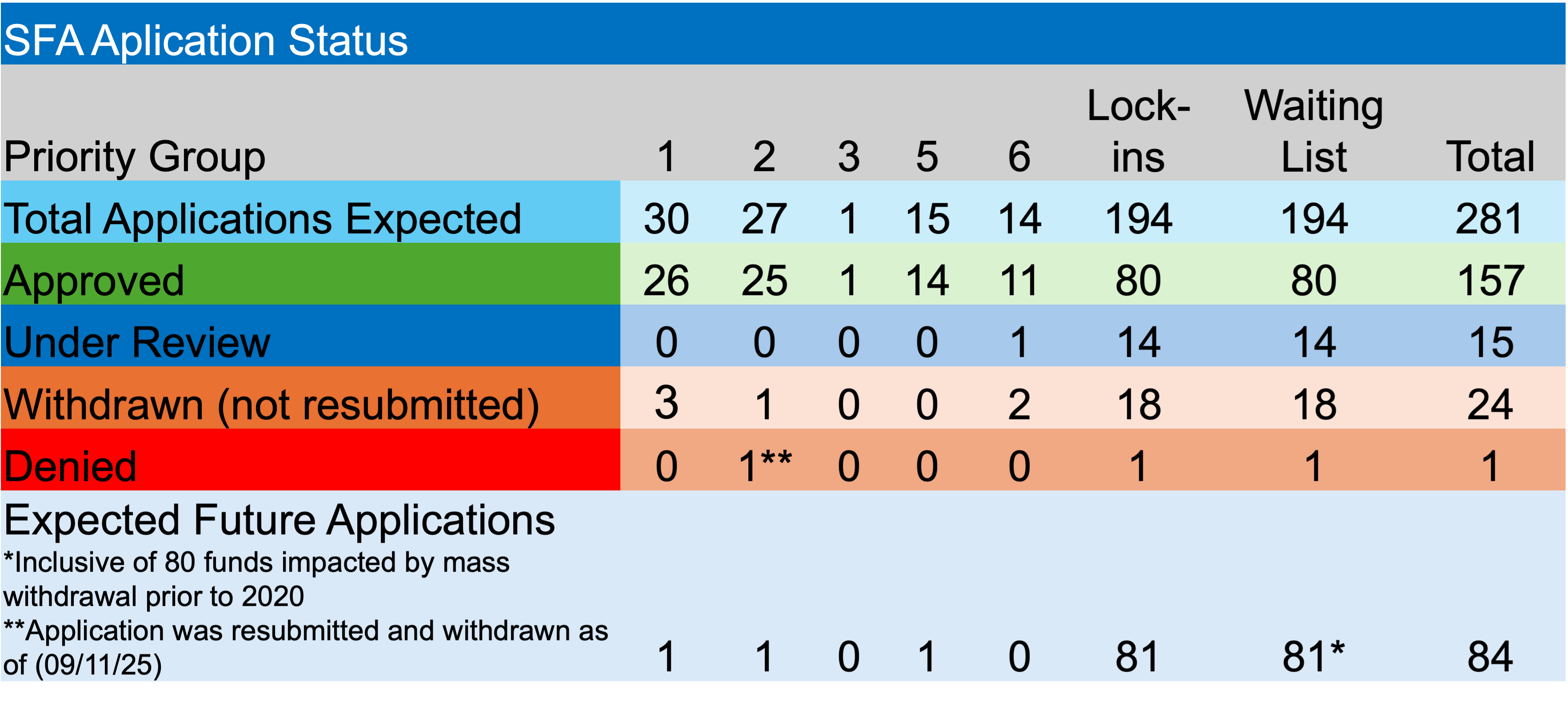
Last week was very quiet regarding ARPA and the PBGC’s implementation of this critical pension legislation. The PBGC has entered an inflection point, in which initial applications are no longer accepted (by legislation) and only revised applications can be resubmitted as of 1/1/26. There are dozens of multiemployer plans that will not be given an opportunity to submit an application for SFA. It is truly unfortunate.

In fact, a significant percentage (78/84) of the applicants that haven’t been called from the waitlist are plans that only became “eligible” following the Second Circuit’s ruling. As a reminder, multiemployer plans that terminated by mass withdrawal (prior to 2020) and are now seeking Special Financial Assistance (SFA) sit in a very narrow and evolving category. Historically, the PBGC treated them as ineligible, the Second Circuit decision has effectively opened the door for some of these plans to file as eligible multiemployer plans under ARPA, provided they still otherwise meet one of the statutory SFA eligibility tests and file by the regular SFA deadlines. There’s the catch, not one of these “mass withdrawal” plans has been given the opportunity to submit an application prior to the December 31, 2025, deadline.

Regarding non-mass withdrawal applicants, the previous week saw no applications submitted, none approved, no plans being denied due to ineligibility, and no plans asked to rebate a portion of the SFA received due to census issues. However, there was one plan that withdrew its initial application. Teamsters Industrial Employees Pension Plan, a non-priority group member, is seeking $27.4 million in SFA for the 1,888 plan participants. They will have the opportunity to resubmit an application until 12/31/26.

It appears that there are roughly 40 funds, including those currently under review and those that withdrew a previous application, that might still be receiving SFA grants. If that is correct, we might eventually have more than 190 pension systems supported by ARPA/PBGC. Amazing. Unfortunately, it appears that more than 80 will not be given the opportunity to file an application with the PBGC.

Milliman: Corporate Pension Funding UP – Again!

By: Russ Kamp, CEO, Ryan ALM, Inc.

Milliman released its monthly Milliman 100 Pension Funding Index (PFI), which analyzes the 100 largest U.S. corporate pension plans. They reported that the funded ratio has now improved for nine straight months – impressive! As of December 31, 2025, the funded ratio for the index constituents is 108.1%, which is up substantially from year end 2024’s 103.6%.

The increase in the funded ratio for December (and the year) was mostly driven by the performance of the assets for the index’s constituents that saw an 11.32% average return for the year, increasing asset values by $53 billion. A rather stable interest rate environment lead to only a $1 billion decline in the PV of those FV liabilities.

According to Zorast Wadia, author of the Milliman 100 Pension Funding Index report, “discount rates fell during the year, and this trend could extend into 2026, potentially reversing some of the recent funded status gains and underscoring the continued need for prudent asset-liability management.” We couldn’t agree more.

It was the significant decline in U.S. interest rates during a nearly four decade bull market for bonds that really crushed funding for private DB pension plans. It would be tragic to witness a deterioration in the funded ratio/status after reclaiming a strong financial footing. Secure those promises and sit back and enjoy managing surplus assets.

Here is the link to the full December report: View this month’s complete Pension Funding Index